

Ask Anything
What ChatGPT’s ‘Your Year In Review’ Reveals About How We Actually Use AI.

Ask Anything
What ChatGPT’s ‘Your Year In Review’ Reveals About How We Actually Use AI.
ChatGPT recently unveiled its year-in-review feature, Your Year With ChatGPT, joining the long tradition of apps that summarize how much of your finite life you spent inside them.
I learned that I’m in the top 0.1% of users by activity, which I’m not sure I should be admitting in public. I was also awarded “most likely to turn a spreadsheet into a subplot,” which is, to be fair, exactly what I’m about to do.
In the recap, users were also assigned an archetype. I am apparently a Strategist (they all sound equally flattering), a group that makes up about 3.6% of the user base. I know that because the app told me, helpfully, after summarizing the things I spend an inordinate amount of time talking about.
Curious what else was out there, I asked friends and pursued Reddit. Incomplete but directionally telling, here’s what I dug up:
Navigator — 23%
Producer — 20%
Engineer — 19%
Operator — 13%
Tinkerer — 9%
Architect — 5%
Strategist — 4%
Pathfinder — 2%
Scholar — 1%
I rounded the percentages. This is not a scientific paper.
And yes, we’re missing four percent. Let’s call them The Mysterious. Or my rounding error.
Each archetype reflects three dimensions: a focus (exploring or specializing), an action (learning, planning, or doing), and an output (practical or conceptual). None are better or worse. They’re just different ways people decide when they’re finished.
For years, the question has been: what is ChatGPT actually for? What problem does it solve? Does it even solve a problem?
On paper, the answers are endless. It writes. It codes. It tutors. It summarizes. It generates images. It plans trips. It debugs workflows. It can now, for reasons that feel slightly beside the point, order groceries.
But Your Year With ChatGPT offered a simpler view—not what these systems can do, but how people actually use them when handed a box that says ask anything.
The vast majority of users cluster around execution-oriented archetypes—Navigators, Producers, Engineers, Operators. Taken together, that’s about 75%. Their stopping rule is simple: I’m done when I have enough to act.
A smaller group—Strategists, Pathfinders, Architects, Scholars, and the like—uses ChatGPT to weigh tradeoffs, guide direction, and rework mental models over time. They don’t stop when an answer appears. They stop when a decision holds—or when their understanding changes, which can take a while.
On its own, this is just a personality quiz with better math. Combined with other consumer data, it starts to resemble a usage model.
In May 2025, OpenAI published its largest study of consumer behavior, analyzing 1.5 million conversations. The findings were stark: 49% of usage was asking questions. 40% was getting work done. Just 11% was “exploring ideas.”
That 11% maps almost exactly onto the conceptual archetypes. The year-in-review and the usage study are telling the same story.
Session length tells it too. Forty-one percent of users complete sessions in under five minutes. The average runs seven to thirteen minutes. But users engaged in creative or exploratory work average thirty-four minutes—the longest of any category.
Most people stop early. A few don’t. The system notices.
The product’s center of gravity isn’t intelligence or creativity, but minimizing the distance between intent and exit.
According to OpenAI’s own disclosures, free-tier accounts represent about 62% of active users—but only 18% of compute. The paying minority consumes the vast majority of resources.
Among paying users, there’s another split. Plus accounts ($20/month) account for roughly 94% of consumer revenue. Pro accounts ($200/month) make up about 6%. But Pro users are so resource-intensive that the tier is unprofitable. Sam Altman has said so publicly.
The heaviest users—the ones who don’t stop—are being subsidized by millions of people who just want an answer and to move on.
And the archetype distribution matches the bill.
What that adds up to is ChatGPT becoming something closer to an extremely capable version of search. You ask a question. You get an answer. The distance between intent and completion keeps shrinking. It can draft the email, book the flight, and Instacart the toilet paper.
What it is not being built to do is linger—to push back, to ask what you mean, to widen the frame. There’s no Socratic method here. Not because that work lacks value, but because sustained, open-ended inquiry is expensive to run and difficult to monetize.
So the product serves two populations with opposing economics. The majority wants clarity and completion, uses it lightly, and converts at $20 a month. The minority wants depth, uses it heavily, and costs more to serve than they pay.
If you want to know who OpenAI is building for, the answer isn’t speculative.
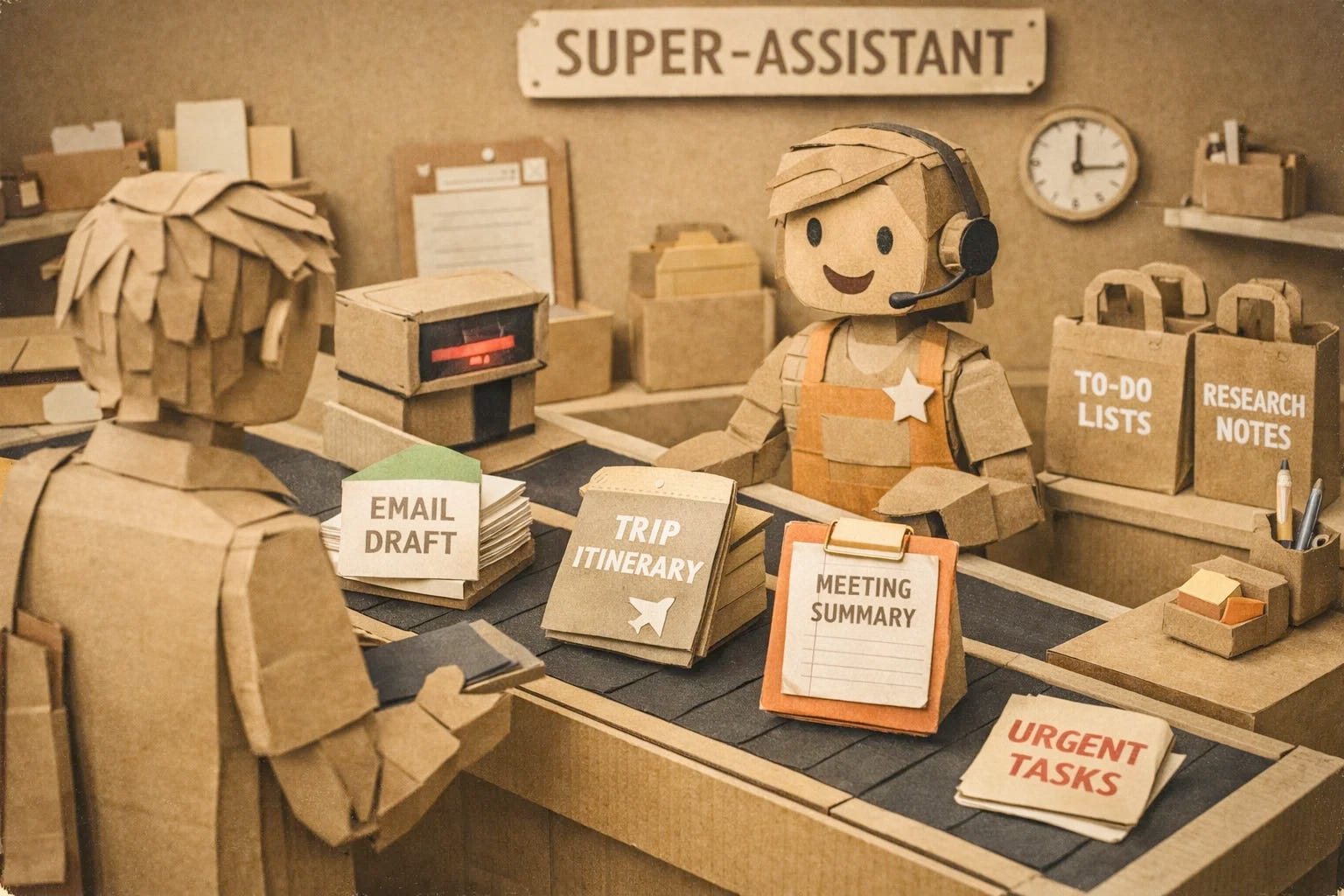
A leaked internal strategy document describes the next phase: ChatGPT as a “super-assistant.” The stated vision is simple—your interface to the internet plus your local drive.
The latest features make that concrete:
Commerce integrations: transactions, bookings, shopping directly inside ChatGPT
Agents that work end-to-end: select, checkout, track
Gmail, Calendar, and Contacts connectors
A “Super Assistant” mode for email, scheduling, trip planning, and external apps
Not one is designed for extended exploration.
Sam Altman framed it directly: the next leap won’t be “more IQ.”
Less thinking. More doing.
To be fair, this leaves the thinking squarely to humans. Which makes sense—LLMs can’t actually think. Human creativity and judgment remain safely in human hands.
But the system also isn’t being optimized to enhance those things. It’s optimized to get more done, faster. Speed over originality. Adam Grant takes this further: AI chatbots may make most of us less creative.
More output. Less input. I’m not convinced that’s the best balance.
“Ask anything” sounds like freedom.
In practice, it mostly means: help me finish.
That’s not a failure of imagination.
It’s just, apparently, the job to be done.
What do you find yourself asking ChatGPT for, over and over again?
Comments are open.
Thanks for reading Opinions & Conditions May Apply!
I read and absorbed this year’s summary of ‘who I am’ and I am already looking forward to next year’s summary. I can then ask ChatGPT to evaluate trends in my usage and my psyche. Assuming it’s honest and not just trying to keep me engaged (but who could ever really know that?) then I should begin to see clearer and clearer into who I am. This is frightening and fascinating.